01history
From a Maeda Lord's Garden to a Public Cultural Landscape
Kenrokuen did not appear as one finished design. The prefectural history traces its conventional beginning to 1676, when the fifth Maeda lord, Tsunanori, built a villa and developed the surrounding slope as Renchitei. Fire damaged part of that garden in 1759. Later lords rebuilt features, changed the plateau above it and expanded ponds and plantings, so the present landscape records several generations of political power, taste and maintenance.
The name Kenrokuen was given in 1822 during the period of the retirement residence Takezawa Palace. After further nineteenth-century change, walls between garden areas were removed and the grounds approached their current integrated form. The garden opened fully to the public in 1874 and later received national cultural-property designation, becoming a Special Place of Scenic Beauty in 1985. Read it as an evolving daimyo garden—not as untouched nature or a single-period reconstruction.
- Conventional start of Renchitei: 1676.
- Name Kenrokuen adopted: 1822.
- Opened fully to the public: 1874.
- Special Place of Scenic Beauty designation: 1985.
context
What the Name Kenrokuen Means: Six Qualities in Three Pairs
Kenrokuen means a garden that combines six qualities. The official interpretation groups them into three complementary pairs: spaciousness and seclusion, artifice and antiquity, and water-courses and panoramas. The point is not that every viewpoint displays six labels at once. The garden asks a walker to experience designed contrasts—an open pond followed by an enclosed path, visibly trained trees that also convey age, and low water features set against views from higher ground.
Use these pairs as a reading tool. At Kasumigaike Pond, notice how open water and carefully positioned objects create breadth. On quieter paths, vegetation and turns suppress the wider city. Stones, bridges, streams and trained pines make human intervention visible, yet weathering softens that intervention over time. Higher viewpoints resolve the apparent conflict between water below and distant panorama. This framework turns the visit from a hunt for one famous lantern into a sequence of landscape decisions.
- Spaciousness and seclusion.
- Artifice and antiquity.
- Water-courses and panoramas.
- Look for transitions between qualities, not six separate exhibits.
highlights
What to Notice Beyond the Kotoji Stone Lantern
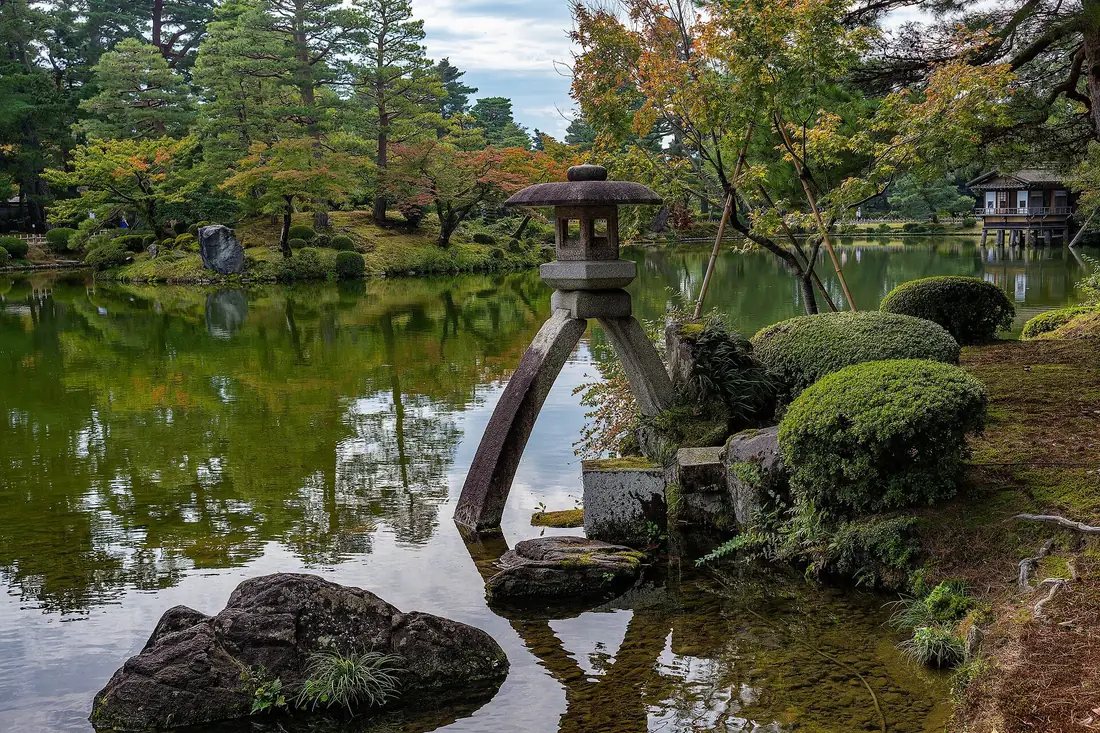
The Kotoji stone lantern beside Kasumigaike Pond is the most recognizable composition, but concentrating every photograph there obscures the garden's range. The official route also identifies Karasaki Pine, the observation point, Neagari Pine, winding streams, Hanami Bridge, Yamazaki Hill, Sazae Hill, Hisagoike Pond, Midori Waterfall and the fountain. Some are focal objects; others only make sense as relationships among water, elevation, planting and a moving viewpoint.
Begin with the pond-and-lantern area, then let the route change scale. Examine the trained structure of old pines, the use of islands as symbols of longevity and the way water links separate scenes. Compare the broad Kasumigaike landscape with the more enclosed Hisagoike area. Teahouses and adjacent cultural facilities add interpretive options but may have separate operating or admission conditions. A complete visit does not require checking every numbered feature; it requires enough movement to understand contrast.
- Kasumigaike Pond and Kotoji stone lantern.
- Karasaki and Neagari pines.
- Streams, bridges, hills and changing elevations.
- Hisagoike Pond and Midori Waterfall.
- Teahouses and adjacent facilities require separate checks.
planning
A Practical 90-Minute First-Visit Route
The management office publishes a 1.3-kilometre standard course with an indicative duration of 90 minutes and recommends moving clockwise. Use that as a scope reference, not a race pace. From the Kotoji lantern area, the route connects the observation point, Karasaki Pine, Kasumigaike Pond, several bridges and planted hills, adjacent cultural facilities, the teahouse area, Hisagoike Pond, waterfall and fountain before returning.
A first-time visitor can simplify the sequence into three chapters: the open pond landscape, the planted interior of hills and streams, and the older lower-garden features. Pause where the view changes rather than at every map number. Photography, wet paths, seasonal crowding and tea can extend the visit well beyond 90 minutes; limited stamina or severe weather can justify a shorter loop. Open the official map before entry and choose an exit that serves the next destination.
- Official standard course: 1.3 kilometres and about 90 minutes.
- Clockwise is the management office's general recommendation.
- Treat 90 minutes as indicative, not guaranteed.
- Choose the exit around the next stop and mobility needs.
access
Getting There—and Choosing a Gate That Fits the Day
From Kanazawa Station, use a current local or sightseeing bus toward the castle-and-garden area. The management office names approaches through Kenrokuen-shita for Katsurazaka, Hirosaka for Mayumizaka, and Dewa-machi for Kodatsuno. These gates serve different edges of a large garden. The official city listing describes a short final walk from the commonly used castle-and-garden stop, but the appropriate stop depends on the intended route.
Katsurazaka works naturally with Kanazawa Castle's Ishikawa Gate side; Mayumizaka connects efficiently with Hirosaka and the 21st Century Museum area. Kodatsuno may support a route chosen for accessibility or eastern-side destinations. Bus patterns, traffic and stop names can change, so verify the operator on the travel date. If arriving by taxi, give the gate rather than only “Kenrokuen.” The map coordinate on this page represents the garden broadly and is not an accessible entrance.
- Katsurazaka: useful for the castle-facing side.
- Mayumizaka: useful for Hirosaka and nearby museums.
- Kodatsuno: a different eastern approach with route implications.
- Specify the gate to a taxi driver.
planning
Opening, Admission and Early Entry: What Must Be Rechecked
Kenrokuen uses season-dependent public opening and admission conditions. The management office also publishes an early-entry arrangement with restricted gates and an instruction to leave before ordinary paid opening. Fees, age categories, exemptions, payment method, combination tickets and teahouse operations are listed separately. Because every one of these details can affect an early or tightly scheduled visit, Which Japan does not freeze the current values into evergreen prose.
Checked on 2026-07-19, the official guidance remains the source to consult immediately before travel. Confirm the date, opening window, last practical entry, available gate and any illumination or special-event change. Do not assume early entry provides full services or that a ticket covers adjacent museums and castle facilities. If the day depends on sunrise photography, a tea service or a concession, verify that specific operation rather than inferring it from garden access.
- Seasonal public opening requires a date-specific check.
- Early entry uses limited gates and a separate exit procedure.
- Fees, exemptions, payment and combination tickets can change.
- Teahouses and neighboring facilities have separate operations.
seasonality
Kenrokuen by Season: Blossoms, Green, Foliage and Yukitsuri
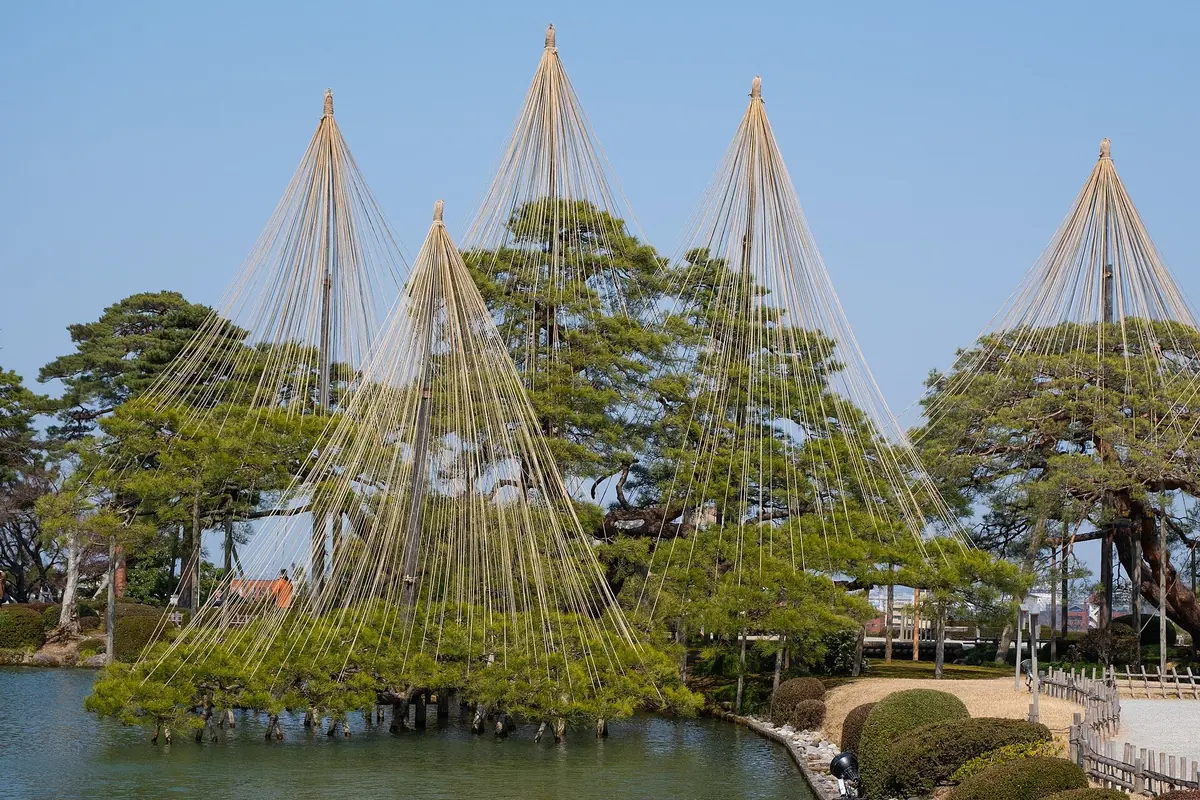
Spring introduces plum and cherry interest at different times; summer emphasizes deep green, water and shade; autumn layers changing leaves across varied species; winter reveals branch structure and the conical ropes of yukitsuri on selected trees. These are landscape processes, not fixed appointment dates. Bloom, color, snow and visibility vary with the year, and annual illuminations operate only on announced dates.
Choose the season by trade-off. Spring and autumn can concentrate visitors at famous viewpoints. Summer heat, humidity and rain increase the physical cost of the slopes. Winter may deliver extraordinary structure even without snow, while wet or icy surfaces require care. Use the garden's current notices, city seasonal information, live camera and short-range forecast near the visit. Never promise a snowy garden or peak foliage from monthly averages alone.
- Spring: plum and cherry timing varies annually.
- Summer: green landscapes with heat, humidity and rain.
- Autumn: foliage develops unevenly across species and dates.
- Winter: yukitsuri is meaningful even when snow is absent.
- Illuminations require current date and gate confirmation.
accessibility
Slopes, Gravel, Wheelchairs and Route-Specific Accessibility
The official route page gives a direct warning: Kenrokuen has many slopes. Gravel, gradients, bridges and weather can make a route more demanding than the map suggests. The management office publishes a barrier-free course and identifies several gates where wheelchairs may be borrowed. Its facilities map also marks multipurpose restrooms and assistance points. None of this makes every scenic feature step-free or suitable without support.
If accessibility is essential, select the gate and course before arrival and confirm current equipment availability. The city accessibility guide notes that wheelchair users may need assistance and describes additional mobility support, while the management map advises care on slopes. Do not interpret a representative coordinate as an entrance. Travelers using canes, strollers or managing fatigue should also favor the defined route, allow extra time and reconsider steep or wet detours.
- Use the official barrier-free course, not the standard route by default.
- Confirm the intended gate and loan equipment before travel.
- Expect gravel, slopes and weather-sensitive surfaces.
- Multipurpose restrooms are mapped but route distance still matters.
etiquette
Garden Etiquette, Photography and Conservation
Kenrokuen is a protected, intensively maintained cultural landscape. Stay on visitor routes, do not touch trained branches or cross barriers for a photograph, and give gardeners and maintenance work space. Keep groups from blocking narrow paths and famous viewpoints. The management guidance prohibits smoking in the garden and does not allow pets. Current signs and staff instructions take priority if a seasonal display, repair or weather condition changes movement.
Ordinary personal photography should remain considerate, but commercial shoots, tripods, drones, costumes, equipment or use of identifiable people can raise separate permission and safety questions. This research pack does not grant image rights. Avoid presenting staff, other visitors or private tea activity as public subjects without consent. Carry rubbish out, protect water edges from dropped items and keep food to permitted areas. A clean composition never justifies leaving the path.
- Stay on permitted routes and behind barriers.
- Do not touch trees, supports, stones or water features.
- Smoking and pets are not allowed under current guidance.
- Current signs decide photography and equipment conditions.
- This page does not grant commercial image permission.
planning
What to Pair with Kenrokuen—and Common Planning Mistakes
Kanazawa Castle Park is the most natural pairing because it faces the garden across the historic core. Hirosaka's museums and cultural facilities work from the Mayumizaka side, while the prefectural traditional-crafts museum and Seisonkaku sit beside or within the broader garden zone under separate conditions. Choose one pairing based on interest and exit gate. Adding the castle, a museum and a complete garden route can already occupy most of a half-day.
Common mistakes are arriving without a gate plan, treating the Kotoji lantern as the whole garden, and copying old opening or illumination details. Another is budgeting 90 minutes while expecting tea, photography and every named feature; the official time is only indicative. Recheck the management page, choose a route compatible with mobility and weather, and leave before fatigue reduces attention. The goal is to read a designed landscape across changing scenes, not to collect every marker.
- Best default pairing: Kanazawa Castle Park.
- Museum pairing: exit toward Hirosaka.
- Check separate admissions and closure days.
- Do not equate a 90-minute route with every optional experience.
- Choose depth over a checklist of map numbers.