01history
A 234-Metre Landmark Shaped by Seaside Momochi
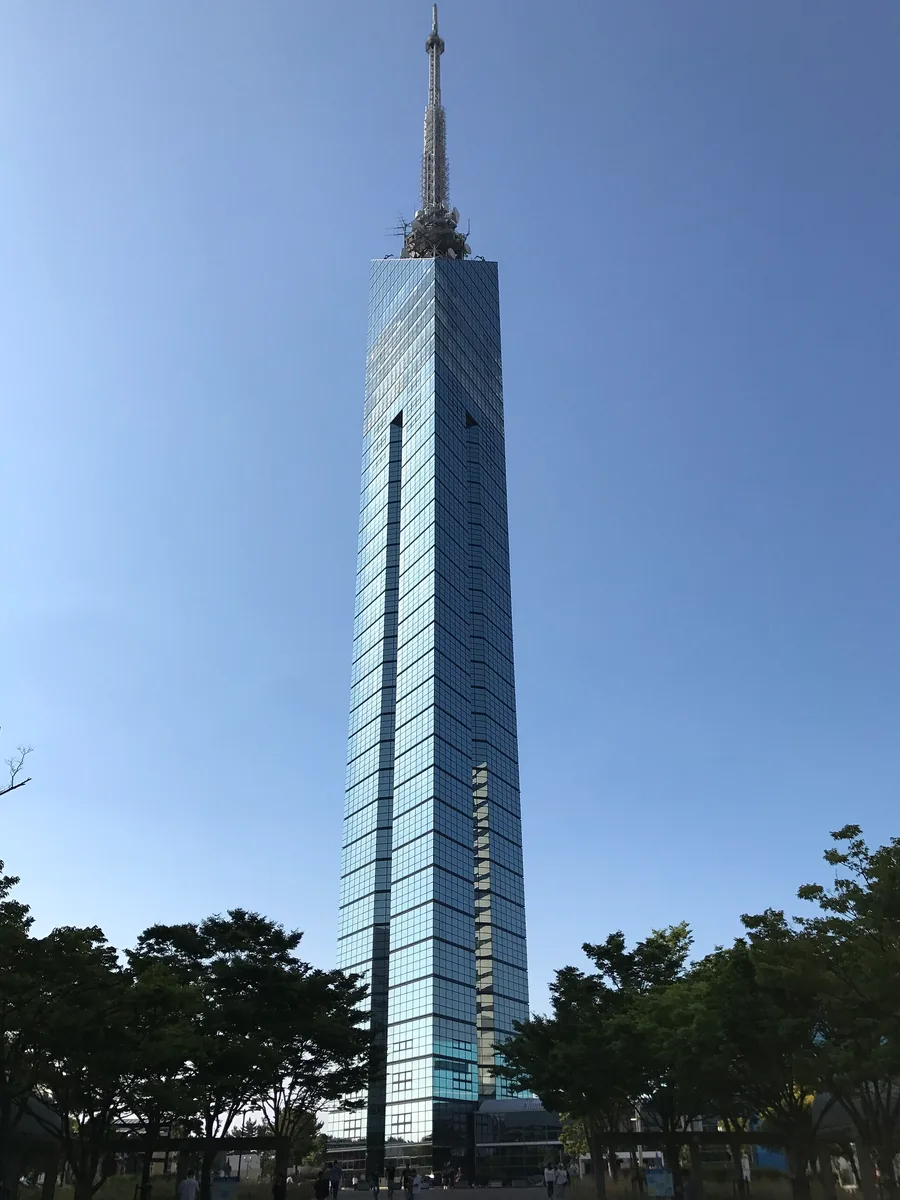
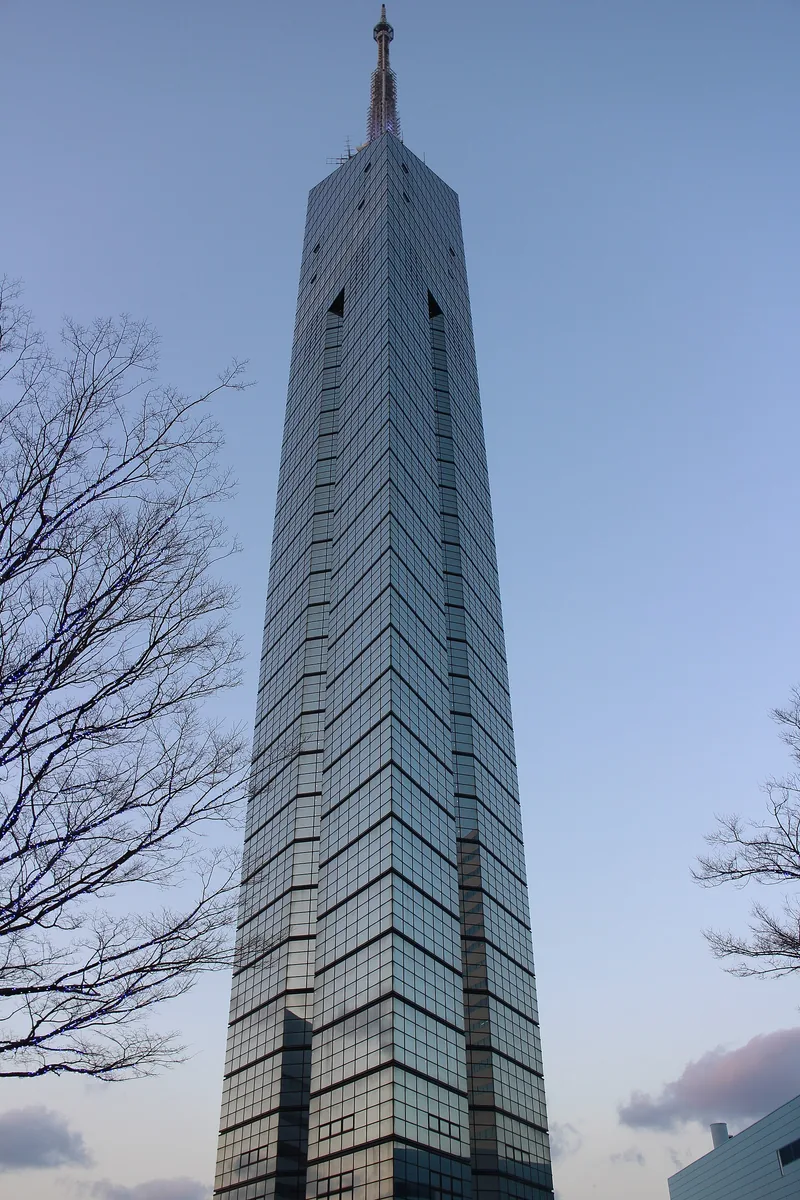
Fukuoka Tower rises 234 metres above Momochihama, but visitors do not go to the tip: its highest public observation floor is 123 metres above ground. The operator describes it as Japan's tallest seaside tower. Its triangular exterior, covered with 8,000 half-mirrors and nicknamed the “Mirror Sail,” makes the building as much a waterfront landmark as an indoor viewpoint.
The tower opened in 1989 as a monument for the Asia-Pacific Exposition held for Fukuoka City's centenary, while also serving broadcasting functions. That origin connects it with Seaside Momochi, a waterfront district developed around the former exposition site. The beach, museums, commercial facilities and event venues explain why the tower works best as the visual anchor of a wider neighborhood visit rather than an isolated stop.
- Total tower height: 234 metres.
- Highest public observation floor: 123 metres.
- Exterior: a triangular form clad in 8,000 half-mirrors.
- Context: a landmark created for the 1989 exposition.
highlights
Three Observation Levels, Three Different Uses
The principal viewpoint is SKY View 123 on Observation 3F. The operator describes a 360-degree panorama: Hakata Bay lies to the north, the urban centers of Tenjin and Hakata are to the east, waterfront sites extend west, and the Sefuri mountain range frames the south. Start here by identifying the coastline and city structure before focusing on individual landmarks.
Observation 2F, at 120 metres, contains a cafe and dining space; using it still requires an observation ticket, and its business conditions should be checked separately. Observation 1F, at 116 metres, emphasizes interactive and photo-oriented features. Exhibits, paid activities and food service can change, so treat the panorama as the dependable core and the entertainment elements as current operator-managed additions.
- Observation 3F: the main 123-metre panorama.
- Observation 2F: views combined with cafe and dining service.
- Observation 1F: interactive features and themed photo areas.
- Use the official floor guide to check what is operating.
experience
A Practical Flow from Ground Floor to Skyline
Buy or present your ticket in the ground-floor entrance, then follow staff directions to SKY Port and the elevator to the highest observation level. Before going up, use the ground-floor toilet if needed: the operator says the general observation floors have no toilet, although the cafe level has one for cafe customers. Re-entry is not currently allowed, so collect everything you need before the ticketed route.
At the top, make one slow circuit to understand the compass directions, then return to the windows with the light and landmarks you prefer. Continue through the lower observation levels according to the current route, pausing for interactive features only if they add value. Finish with ground-floor information or shopping rather than allowing those optional elements to displace the principal view.
- Use the ground-floor facilities before entering.
- Begin with a full circuit of SKY View 123.
- Check each direction before choosing a photo position.
- Follow the current signed route through lower levels.
- Do not plan on leaving and re-entering.
access
Choosing Between Direct Bus, Subway and Car
Direct Nishitetsu buses are often the simplest choice from Hakata or Tenjin because the operator lists stops at Fukuoka Tower or Fukuoka Tower Minamiguchi. Route numbers, platforms and journey times are timetable-dependent, so use the live bus planner rather than memorizing the examples on a travel article. On event days, road congestion can make a generous return buffer important.
The subway offers a rail-first alternative: take the Airport Line to Nishijin, then walk or transfer to a bus. The official tourism listing describes the walk as roughly 20 minutes, making it a real neighborhood approach rather than a station-adjacent stop. Drivers can use the tower parking area, but capacity, special event-day pricing and road conditions should be checked on the operator's current car-access page.
- From Hakata or Tenjin: compare live direct-bus options.
- By subway: use Nishijin, then walk or transfer.
- Save the return stop and timetable before entering.
- On event days, allow for road and parking pressure.
planning
How Long to Allow and When to Arrive for Sunset
Allow about 45–90 minutes for the tower itself as an editorial planning range, not an operator-published average. The shorter end suits a focused circuit of the main view; the longer end allows for queues, interactive floors, photos and a slower look at the city. Cafe time, shopping, the beach and the museum belong outside that estimate.
For a daylight-to-night transition, arrive well before the published sunset rather than at the last light. You need time for ticketing, an elevator queue and orientation before the color changes. Sunset is an obvious demand peak, and the operator warns that final admission may be brought forward when crowded. A timed onward reservation immediately afterward removes useful flexibility.
- Focused panorama: plan around 45 minutes.
- Fuller first visit: allow up to 90 minutes.
- Add separate time for food and Momochi walks.
- For sunset, enter before the color change begins.
- Avoid a tight fixed departure after a peak visit.
planning
Treat Tickets, Hours and Closures as Live Information
Admission prices, age categories, discounts, payment methods, opening hours, last entry and annual closure dates are operational facts, not permanent characteristics of the tower. The operator publishes them together on its admission page and links to advance tickets. Check that page for the actual visit date, especially if an old search result, map listing or screenshot shows a different value.
Closing time is not the same as the last time you can join the visit. The operator also states that admission may end earlier when crowding requires it. Maintenance, private use, severe weather or special operations can affect access, while cafes and shops may follow separate schedules. Recheck shortly before departure and keep a waterfront alternative if the observation route is unavailable.
- Verify the operator's admission page for your date.
- Distinguish closing time from final admission.
- Check age bands and discount evidence before purchase.
- Confirm annual closure and temporary notices.
- Check restaurants and shops separately.
accessibility
Accessibility and a Smoother Family Visit
The ticketed observation route is reached by elevator, and the ground-floor entrance has a wheelchair-accessible toilet. The operator lists free wheelchair loans at the ticket counter, subject to limited availability. Visitors who need particular elevator dimensions, transfer assistance, an accessible arrival point or a guaranteed loan should contact the tower before travel rather than assuming every need is covered by the general facility description.
For families, the ground-floor facilities include a nursing room in the women's restroom and lockers near the north-side entrance. Use the toilet before ascending because the general observation floors do not have one. Assistance dogs are admitted, while ordinary pets are not currently allowed even in carriers. These policies and the location or availability of equipment should be checked again for the visit date.
- Ask the ticket counter about limited wheelchair loans.
- Use the accessible ground-floor toilet before ascending.
- Confirm assistance needs directly with the operator.
- Keep children's essentials with you because re-entry is unavailable.
- Check the current assistance-dog and pet policy.
seasonality
Indoor Comfort Does Not Guarantee a Clear View
The observation rooms are indoors, which makes the tower useful in heat, cold or light rain, but the product you are buying is still weather-dependent. Haze, low cloud, rain on the glass and strong backlight can reduce distant detail. On clearer days, the directional panorama extends from Hakata Bay and the urban core to the Sefuri mountains; no landmark should be promised on a specific visit.
Check the short-range forecast and visible sky before committing a tightly timed stop. Daylight is better for reading the coastline and neighborhood structure, sunset adds rapid changes in color, and darkness emphasizes the road and building lights. If visibility is poor, focus on the near waterfront, floor interpretation and the tower's mirrored structure, then use the beach or museum as conditions allow.
- Clear daylight favors geographic orientation.
- Sunset requires extra queue and timing margin.
- Night emphasizes the illuminated urban pattern.
- Rain protection inside does not ensure distant visibility.
- Keep a flexible Momochi alternative for poor conditions.
etiquette
Photography Without Blocking the View
The operator provides designated photo features on the observation and ground floors, but the windows and narrow viewpoints are shared. Keep bags and equipment out of circulation routes, take turns at the glass and avoid making other visitors the main subject without consent. Reflections are strongest when a lens or phone is held away from the window; never press equipment against glass or fixtures unless staff explicitly permits it.
No comprehensive personal-equipment policy was found in the reviewed official pages, so ask before setting up a tripod, light or staged shoot. Business-purpose reporting or photography on the grounds or inside requires advance application, and the operator says use of Fukuoka Tower imagery also requires an application. Ordinary admission should not be treated as permission for commercial production or image reuse.
- Use designated photo areas when they meet your needs.
- Do not occupy a window longer than necessary.
- Keep tripods and bags out of shared routes.
- Ask staff when an equipment rule is unclear.
- Apply in advance for business-purpose photography or image use.
nearby
Build a Momochi Half Day Around the Tower
The simplest pairing is Seaside Momochi Beach Park and Marizon, immediately north of the tower area. Visit the waterfront in daylight, then use the tower for a higher reading of the same coastline. Fukuoka City Museum adds the region's history and overseas-exchange context in the same district, but its hours, closure calendar, exhibitions and admission need a separate current check.
Event venues and shopping facilities broaden the neighborhood, yet their crowds can also affect buses, roads and parking. Common mistakes are budgeting only for the elevator view, assuming the subway exits beside the tower, or scheduling sunset without queue time. Choose one substantial nearby pairing, check both facilities independently and save the live return route before starting the visit.
- Scenery pairing: tower plus the beach and Marizon.
- Culture pairing: tower plus Fukuoka City Museum.
- Check venue events before relying on road travel.
- Do not treat Nishijin as a tower-adjacent station.
- Give each paired facility its own operating check.